
In industrial environments, problems don’t just live in servers — they live in pipelines, power grids, production lines, and other OT assets. A small anomaly in a control system can mean more than data loss. It can mean downtime. Safety risks. Environmental impact. So who’s mission control when cyber meets physical?
It’s the IT/OT Security Operations Center (SOC) — and platforms like Yokogawa OpreX IT/OT SOC are redefining what that mission looks like.
Walk into a modern IT/OT SOC and you’ll see more than dashboards. You’ll see operational context, industrial protocols, and analysts who understand both cyber threats and physical processes.
Because in OT, security isn’t just about data.
It’s about keeping the real world running.

Who is mission control? Well, it’s the IT/OT Security Operations Center (SOC) — and platforms like Yokogawa OpreX IT/OT SOC are redefining what that mission looks like.
Walk into a modern IT/OT SOC and you’ll see more than dashboards. You’ll see operational context, industrial protocols, and analysts who understand both cyber threats and physical processes.
Because in OT, security isn’t just about data.
It’s about keeping the real world running.
Unifying people, processes, and technology
A converged IT/OT Security Operations Center (SOC) connects enterprise IT with operational technology, creating full visibility across both environments. Its mission is simple: protect critical systems without disrupting operations.
Behind the scenes, a specialized team makes this possible. SOC managers guide strategy and daily operations, analysts investigate threats (from initial triage to advanced incidents), and engineers design secure, reliable systems. Threat intelligence experts proactively hunt risks, while forensics specialists analyze incidents to learn and improve defenses.
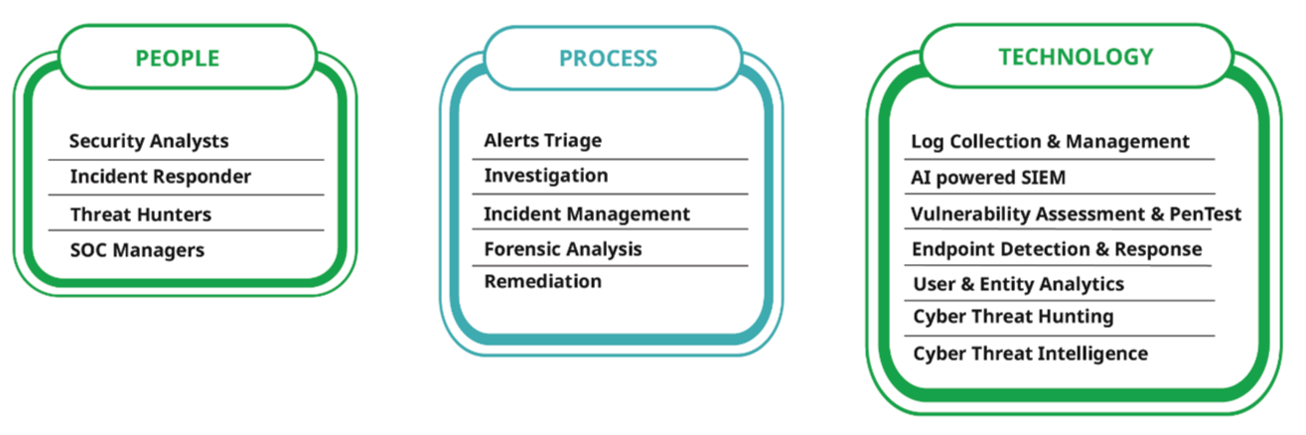
To succeed, an IT/OT SOC relies on three pillars:
People: IT and OT experts working together
Process: Detecting and responding without impacting operations
Technology: Integrated tools that provide visibility, intelligence, and controlled automation across both IT and industrial systems
In short, the mission of an IT/OT SOC is to unify people, processes, and technology to secure critical infrastructure in an increasingly connected world.
Take a Virtual Tour
Some organizations choose to outsource their SOC function to managed security service providers such as Yokogawa. For those we have created a virtual tour that allows you to step inside our IT/OT SOC and see how modern IT/OT security comes to life. Explore real-world scenarios, understand how threats are detected and managed, and discover how integrated visibility helps protect both digital and industrial environments.
Link: Virtual SOC Tour
Frequently Asked Questions about Yokogawa’s OpreX IT/OT Security Operations Center:
How does a SOC reduce business risk and downtime?
A SOC reduces risk by detecting threats early and responding quickly to prevent disruption. Continuous and pro-active monitoring, prioritization of critical assets, and standardized response processes help stop incidents before they impact operations, safety, or revenue.
What types of threats does an IT/OT SOC protect against?
The SOC protects against cyber and operational threats across IT and OT, including malware, ransomware, unauthorized access, phishing, and insider threats. In OT, it focuses on risks to availability and safety, such as ICS/SCADA attacks, process manipulation, and IT-to-OT lateral movement.
What makes Yokogawa’s converged IT/OT SOC different from others?
It’s built for industrial environments, combining IT and OT expertise. It prioritizes safety and operational continuity, understands industrial systems, and minimizes disruption while improving threat detection.
Why do organizations with OT need a converged IT/OT SOC?
As IT and OT systems become more connected, cyber risks increase. A converged SOC helps detect threats early and prevents IT incidents from impacting production, safety, and physical assets.
What does the SOC team consist of?
A SOC team includes analysts, threat intelligence experts, incident responders, security engineers, architects, and specialists in forensics and vulnerability testing, all working together to protect IT and OT environments.
What happens when a threat is detected by your SOC analysts?
SOC analysts triage the alert, assess its impact, and escalate it with clear actions. It’s logged in a ticketing system, triggering a structured process for investigation and quick resolution.